


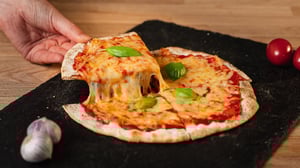
How to achieve stable stretch and controlled melt in pizza cheese
Why Cold-Process Functionality Matters Today
Developing plant-based pizza cheese that delivers consistent stretch and bite across real-life temperature conditions remains a key technical challenge. CheeseMaker CF66 is a potato starch-based ingredient developed specifically for pizza cheese applications, delivering stretch up to 15 cm that remains stable from 80°C down to 20°C .
Here is how manufacturers can approach optimisation.
1. Target Stretch Stability Across Temperatures
Traditional mozzarella stretches optimally at high temperatures and gradually firms as it cools. In plant-based systems, stretch often decreases rapidly as temperature drops.
CheeseMaker CF66 delivers stable stretch of up to 10 cm across 20–80°C, with stretches up to 20 cm at lower temperatures . This stability supports performance not only during baking, but also as the pizza cools during serving or delivery.
When developing plant-based pizza cheese, temperature stability should therefore be evaluated across the full range from oven to consumption.
Formulations can also include up to 8% added plant protein when using CheeseMaker CF66. This enables manufacturers to adjust texture and align with protein-focused product strategies while maintaining stretch and shredability.
2. Maintain Controlled Melt and Firm Bite
In addition to stretch, controlled melt and bite are essential for pizza applications.
Our CheeseMaker CF66 provides a firm yet elastic texture while maintaining controlled melt. This helps prevent excessive flow or runniness, sometimes observed in dairy-free systems.
The ingredient is designed specifically for pizza cheese applications and supports a mozzarella-like texture.
3. Consider Hybrid Dry Mix Formats
CheeseMaker CF66 can be used in fully plant-based cheese or in dry mix formats blended with traditional cheese.
The dry mix format allows finished plant-based cheese made with CF66 to be blended with mozzarella, typically in ratios between 40:60 and 60:40.
In this combination:
• Mozzarella provides optimal stretch at higher temperatures (75–70°C)
• CheeseMaker CF66 contributes stretchability at lower temperatures (around 40°C)
This approach supports consistent performance during cooking, handling and delivery.
4. Quantify Sustainability Improvements
Independent third party analysis shows that replacing dairy components in pizza cheese using KMC ingredients can reduce CO₂ emissions by:
• 4.7% to 63.4% compared to mozzarella-based reference products
• 9.5% to 40.3% compared to rennet casein-based pizza cheese
The actual reduction depends on formulation design and replacement ratio. However, hybrid and fully plant-based solutions both offer tangible progress toward decarbonisation goals.
Importantly, these gains are achieved without sacrificing stretch, bite or shred performance - ensuring that sustainability initiatives align with commercial viability.
Optimising plant-based pizza cheese requires attention to stretch stability, controlled melt, texture tuning, sustainability impact and processing efficiency.
CheeseMaker CF66 provides documented functionality across these parameters, enabling manufacturers to develop both fully plant-based and hybrid pizza cheese solutions with measurable performance and CO₂ reduction potential.
Contact KMC to explore how CheeseMaker CF66 can support your plant-based pizza cheese development.
.jpg?width=300&name=KMC_Ost-008%20(1).jpg)